How to Write an SOP for a Small Business
A standard operating procedure (SOP) is a written page for a job you do again and again. It says what starts the job, who owns it, the steps in order, and how you know the job was done right. This guide shows how to write one for a small service business. It works for a team of one. It works for a crew of five.
The method borrows from a public source written for a very different world: the US Environmental Protection Agency’s guidance on preparing SOPs. The EPA wrote it for labs and field teams. Its rules hold up well for a cleaning route, a client onboarding, or a short-term rental turnover.
What an SOP is, and what it is not
The EPA defines an SOP as “a set of written instructions that document a routine or repetitive activity followed by an organization.” Two words matter there: routine and repetitive. A one-off project does not need an SOP. A job you run every week does.
An SOP is not a policy. A policy says what is allowed. An SOP says how a job gets done. It is also not a checklist, although it usually contains one. The EPA puts it plainly: “the checklist is not the SOP, but a part of the SOP.”
An SOP is not a growth plan either. A written procedure will not bring in clients or fix a weak offer. It makes the work you already do more consistent. The EPA names that benefit directly. SOPs minimize variation and promote quality “through consistent implementation of a process or procedure within the organization, even if there are temporary or permanent personnel changes.” In a small business, a personnel change can be as simple as you taking a week off.
Which jobs to write down first
Start with jobs that pass three tests.
- The job repeats. Weekly or more often is a good line.
- Someone else could do it, or will need to soon.
- A missed step costs you something you can see: a redo, an awkward client email, a late invoice.
For most service businesses, the first list looks alike. Intake of a new lead. Quoting or scoping. The job itself. A quality check. Invoicing and follow-up. Pick one. Do not try to write ten pages in a weekend.
The EPA guidance also says who should write the page: “individuals knowledgeable with the activity,” the people “who actually perform the work or use the process.” In a small business, that is usually you. If a contractor or an assistant does the job, ask them to draft it, then review it yourself.
The seven fields every SOP page needs
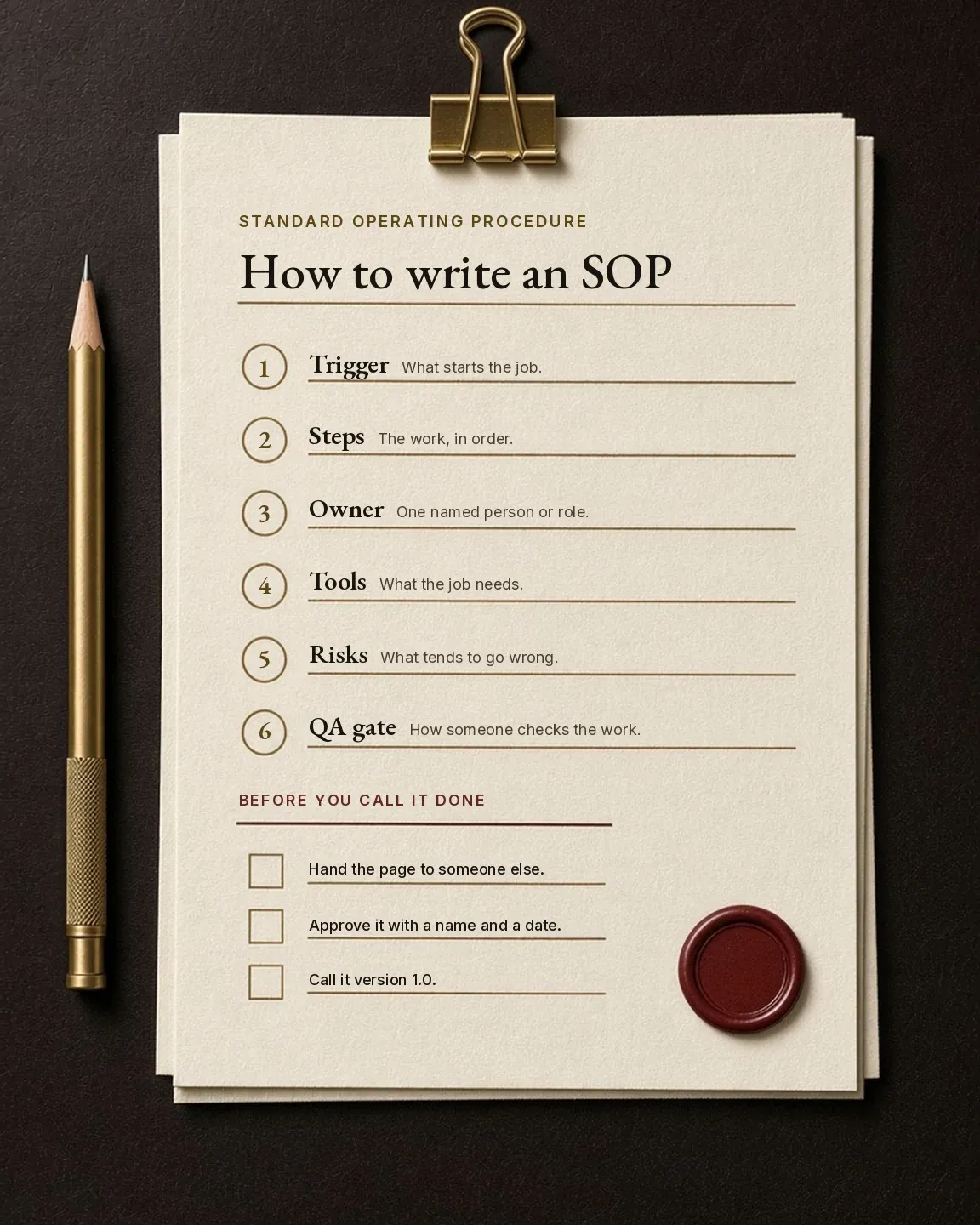
The EPA lists sections for a full SOP, including purpose, scope, procedures, quality control and references. A small business can use a shorter set. Seven fields cover most jobs.
Trigger
What starts the job. “A lead fills in the contact form.” “A guest checks out.” Without a trigger, nobody knows when the page applies.
Steps
The work, in order. Number them. Put one action in each step.
Owner
One named person or role who is responsible. On a team of one, that is you. It is still worth writing down.
Tools
What the job needs: the template, the form, the supplies, the folder. Name them. Keep passwords and access codes off the page.
Risks
What tends to go wrong, and what not to do. “Do not quote rooms the client did not ask for.”
QA gate
How someone checks the work before calling it done. This is the field people leave out most.
Version
A number and a date. The EPA notes that “the revision number and date are very useful in identifying the SOP in use.” When the job changes, the number changes.
These are the same seven fields used in the AI SOP Builder for Small Teams: “Trigger, steps, owner, tools, risks, a QA gate, and a version. A page missing one is still a draft.” That last line is a good rule on its own.
How to write the steps
Most SOPs fail on the steps. They are too long, too vague, or written for the person who already knows the job.
The EPA’s style rules are short enough to tape to a wall. SOPs “should be written in a concise, step-by-step, easy-to-read format.” They use “the active voice and present verb tense.” And: “Keep it simple and short.”
In practice:
- Start each step with a verb. “Confirm the address.” “Photograph the finished room.”
- Put one action in each step. If a step contains “and,” it may be two steps.
- Say where things live. “The quote template is in Clients / Templates.”
- Write down the decision points. “If the client asks for a deep clean, use the deep-clean scope. If not, confirm before you start.”
Then test the level of detail. The EPA sets the bar: write so that “someone with limited experience with or knowledge of the procedure, but with a basic understanding, can successfully reproduce the procedure when unsupervised.” Hand the page to someone who has not done the job. Watch where they stop to ask a question. That spot needs another line.
Checklists: the part people use on the job
The full SOP explains the job. The checklist is what someone ticks while doing it. The EPA notes that checklists are used “to ensure that steps are followed in order” and “to document completed actions.”
A useful pattern for service work: build the checklist from the scope, then use the same list for the quality check. The Cleaning Business Ops Kit works this way. Its job checklist is “the rooms on that quote, in the order you will walk them.” Its QC pass is “a walk against that same list before you call the job done.” With one list for the work and the check, nothing gets checked that was not promised, and nothing promised goes unchecked.
To see that pattern before you buy anything, the Cleaning Room-by-Room Checklist free starter includes a per-visit room walk table, a client intake worksheet and the job-checklist procedure. Short-term rental hosts can look at the STR Turnover Checklist + Cleaner Brief free starter.
Review, approval and versions
A draft SOP is not finished until someone other than the writer has used it. The EPA says it is “especially helpful if draft SOPs are actually tested by individuals other than the original writer before the SOPs are finalized.”
Then someone approves it. In a large organization, that may be a supervisor and a quality officer. The EPA notes that “signature approval indicates that an SOP has been both reviewed and approved by management.” In a small business, approval can be one line at the bottom of the page: a name and a date. On a team of one, the owner and the approver may be the same person. What matters is that a person decided the page is right.
SOPs also go stale. The EPA says “SOPs need to remain current to be useful” and suggests a periodic review, “e.g. every 1-2 years.” A small business that changes faster may want a shorter cycle. A simple rule works: whenever the job changes, update the page and raise the version number. If you stop doing a job, archive its page so nobody follows it by mistake.
Using AI to draft an SOP without letting it approve one
A chat model can turn rough notes into numbered steps quickly. It can also get things wrong with confidence. The US National Institute of Standards and Technology (NIST) calls this confabulation: “the production of confidently stated but erroneous or false content (known colloquially as ‘hallucinations’ or ‘fabrications’).”
That risk changes how you use a model for SOPs. It does not rule the model out.
- Write your notes first. Fill in the trigger, the owner and the QA gate yourself before you ask for steps. The model then shapes your facts instead of supplying its own.
- Paste only what you are allowed to share. Client names, addresses, access codes and passwords stay out of the prompt.
- Critique the draft against the real job. Read every step and ask one question: is this what we actually do?
- A person approves. A model can draft. It does not sign.
The AI SOP Builder follows that order: notes first, an optional draft, a critique, then a sign-off where “Approved is a person’s name.” It also says a model is not required: “The schema is paper. The critique can be done by hand.”
If several people on your team use AI tools, the drafting rules belong on their own page. The AI Governance Starter Pack for Small Teams covers acceptable use, data tiers, do-not-paste rules, an approved-tools register and human-review gates. It is not legal advice, and it is not a certification. To score a draft before it goes out, the AI Critique QA Scorecard gives six marks: accuracy, voice, claim risk, the ask, a privacy pass and a sign-off.
A one-week plan for your first SOP
- Day 1. List every job you repeat. Circle the one where a missed step hurts most.
- Day 2. Fill in the trigger, owner, tools and risks.
- Day 3. Write the steps the next time you do the job, while you do it.
- Day 4. Add the QA gate. Turn the steps into a checklist.
- Day 5. Hand the page to someone else, or follow it yourself word for word. Fix the gaps.
- Day 6. Approve it with a name and a date. Call it version 1.0.
- Day 7. Put it where the work happens: a shared folder, a Notion page, or a printed sheet.
Then pick the next job.
Templates for specific kinds of work
You can write every SOP from a blank page. If you would rather start from a written loop, the Knowledge Mercantile catalog has file kits for specific jobs. Each kit is a folder of procedures, worksheets and scripts you send yourself. The kits are files, not an app. They do not send mail or book jobs for you.
- Solo operators: Solo Business OS Lite includes twelve starter SOPs, from capturing a lead to handing the week to a Friday close. It ships as a Markdown build spec with CSV samples, and a free Notion plan is enough.
- Client work: the Client Onboarding & Delivery OS takes one client from intake through handoff, with ten procedures and ten email scripts.
- Trades and field services: there are ops kits for painting contractors, roofing contractors, pressure and soft-wash operators and mobile auto detailers.
- Pets and property: kits for pet sitting and dog walking, Airbnb and short-term rental hosts and long-term landlords.
Browse the full catalog for the rest. One-time kits come with a 14-day guarantee: if a kit doesn’t work for you, email support with your order number within 14 days for a full refund. The limits are on the refund page.
Sources
- U.S. Environmental Protection Agency. Guidance for Preparing Standard Operating Procedures (SOPs), EPA QA/G-6, April 2007. https://www.epa.gov/quality/guidance-preparing-standard-operating-procedures-epa-qag-6-march-2001
- National Institute of Standards and Technology. Artificial Intelligence Risk Management Framework: Generative Artificial Intelligence Profile, NIST AI 600-1. https://www.nist.gov/publications/artificial-intelligence-risk-management-framework-generative-artificial-intelligence